Branthixeria
Grid Blueprint
Grid Blueprint
Couldn't load pickup availability
- 📥 Digital file available after purchase
- 📚 Long-term availability
- 🔒 Secure checkout
- 📅 Content updated in 2026
Self-paced learning overview
Share
1. Problem Statement
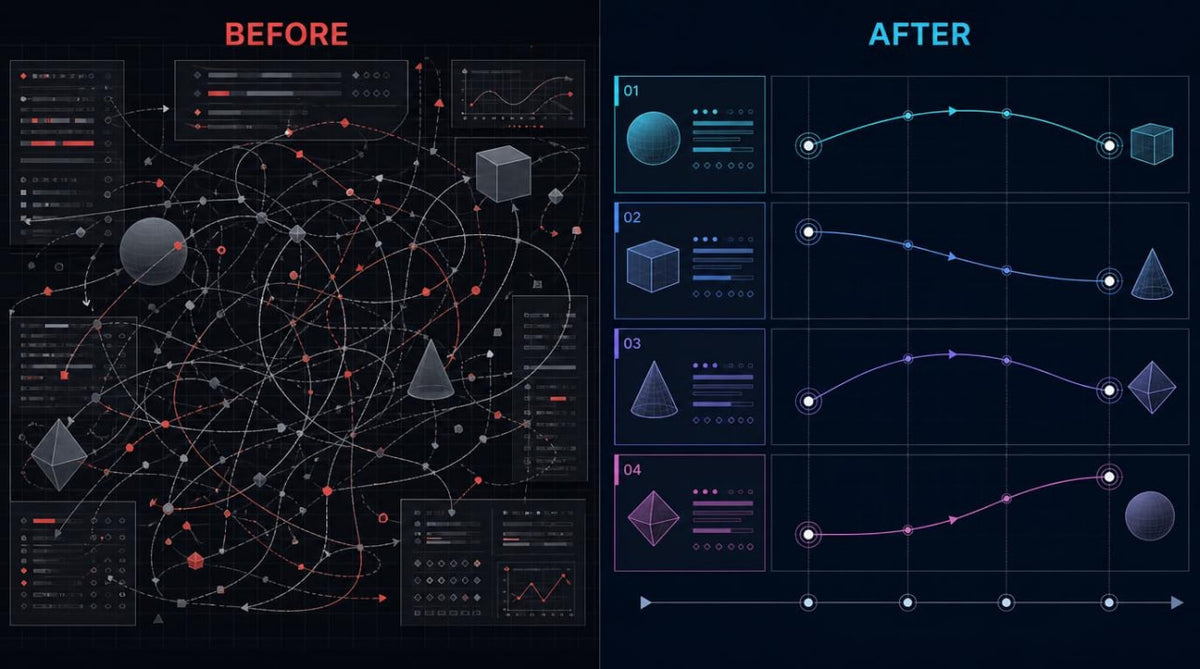
Creating multi-element animated compositions requires organizing graphic elements according to a shared spatial structure. Without a thoughtful alignment system, objects may lose their compositional relationships during movement, scaling, or positional changes. Inconsistent spacing, proportions, and movement directions can make visual coordination between individual scenes more difficult. Dynamic compositions also require an understanding of how geometric grids interact with timing intervals and animated transitions. Further study of Motion Design involves exploring modular organization, spatial hierarchy, and structured arrangements of moving elements.
2. Solution
Grid Blueprint introduces a sequential approach to constructing animated compositions using geometric grids and modular structures. The educational materials explain alignment principles, proportional relationships, spacing, and the positioning of graphic objects. Dedicated modules explore adaptive compositions, movement between grid positions, and the organization of repeating structures. Practical examples demonstrate how spatial rules can interact with animated transitions, rhythm, and visual hierarchy. Course exercises invite learners to create composition diagrams, analyze geometric relationships, and plan original modular animation systems.
3. What's Inside
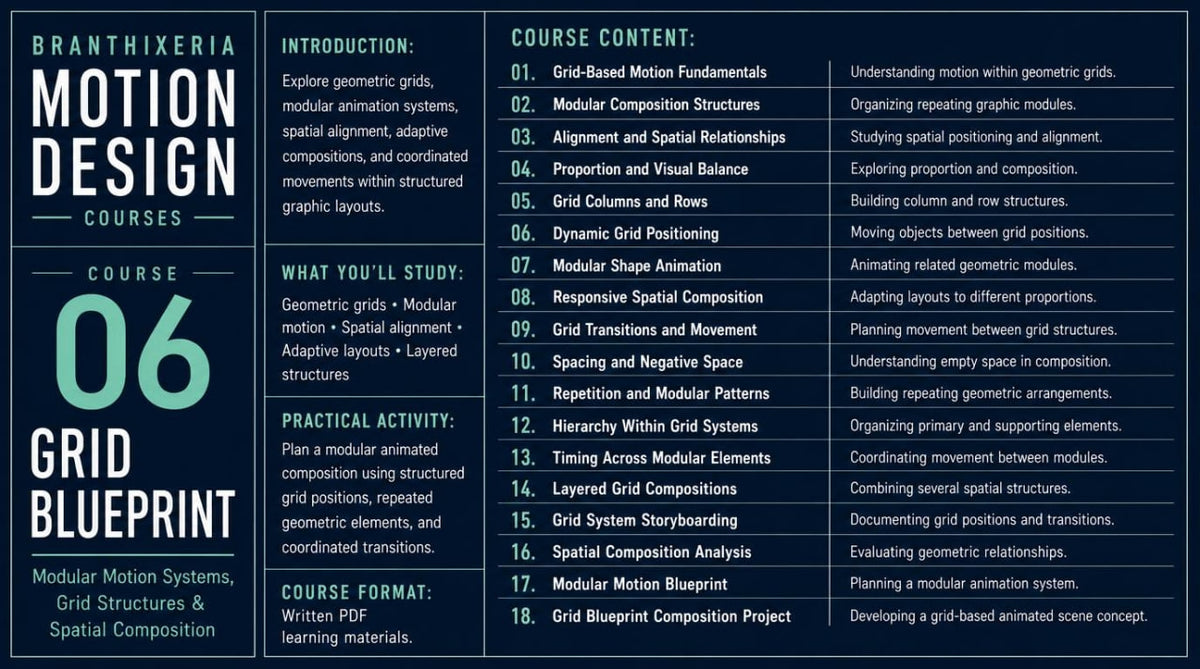
Module 1: Grid-Based Motion Fundamentals
Explore the principles of using geometric grids to organize animated compositions.
Module 2: Modular Composition Structures
Study modular elements and methods of combining them into organized graphic structures.
Module 3: Alignment and Spatial Relationships
Examine object alignment, spatial intervals, and compositional relationships.
Module 4: Proportion and Visual Balance
Explore proportional relationships, object dimensions, and visual balance principles.
Module 5: Grid Columns and Rows
Study the construction of column-based and row-based grids for arranging graphic elements.
Module 6: Dynamic Grid Positioning
Investigate animated object movement between defined positions within a grid.
Module 7: Modular Shape Animation
Examine animation of repeating geometric blocks and their visual interactions.
Module 8: Responsive Spatial Composition
Explore adapting compositional structures to different canvas dimensions and proportions.
Module 9: Grid Transitions and Movement
Study transitions between grid configurations and methods of organizing movement.
Module 10: Spacing and Negative Space
Examine the role of spacing and negative space within dynamic graphic compositions.
Module 11: Repetition and Modular Patterns
Explore repeating modules, geometric relationships, and rhythmic structures.
Module 12: Hierarchy Within Grid Systems
Study the organization of primary and supporting elements within grid compositions.
Module 13: Timing Across Modular Elements
Investigate timing coordination between multiple elements in modular animation systems.
Module 14: Layered Grid Compositions
Explore combining multiple grid structures and graphic layers within animated scenes.
Module 15: Grid System Storyboarding
Create storyboards documenting modular positions, movement trajectories, and composition changes.
Module 16: Spatial Composition Analysis
Analyze geometric relationships, visual balance, and animated scene structures.
Module 17: Modular Motion Blueprint
Plan a modular animation system with defined rules for object positioning and movement.
Module 18: Grid Blueprint Composition Project
Develop a concept for a layered animated composition combining geometric grids, repeating modules, and coordinated transitions.
4. Who Is This For?
✅ Suitable if you:
- Are familiar with Motion Design principles and layered composition structures.
- Want to explore geometric grids and modular animation systems.
- Are interested in spatial organization of graphic elements.
- Would like to study adaptive composition principles.
- Want to develop structured animation planning skills.
- Prefer written materials, composition diagrams, and practical exercises.
- Plan to work with more detailed geometric and multi-element scenes.
❌ May not suit you if you:
- Have not yet explored foundational composition and animation principles.
- Are looking exclusively for introductory Motion Design materials.
- Expect ready-made graphic templates without educational explanations.
- Require individual instructor-led training.
- Need instructions for a particular software environment.
- Do not plan to complete independent composition exercises.
5. What You'll Learn
- Constructing geometric grids.
- Organizing modular compositions.
- Aligning graphic elements.
- Animating grid structures.
- Adapting spatial layouts.
- Coordinating modular movements.
- Creating composition diagrams.
- Planning layered scenes.
6. Refund Policy
Paid Branthixeria courses include a 14-day period for submitting refund requests.
Requests are reviewed according to the store's published refund policy and applicable law. Separate conditions may apply to digital educational materials depending on their delivery method and relevant consumer rights.
What format are Branthixeria courses provided in?
What format are Branthixeria courses provided in?
Branthixeria courses are presented as written PDF coursebooks containing thematic modules, explanations, examples, and practical exercises. The materials are organized for sequential study, allowing learners to revisit individual sections whenever they wish to review a topic. Each course focuses on a defined range of Motion Design subjects.
Do I need previous Motion Design experience?
Do I need previous Motion Design experience?
The learning collection covers different stages of Motion Design study. Introductory courses explain fundamental concepts, while later materials explore more detailed animation principles, composition methods, and visual movement structures. We recommend reviewing each course outline before choosing your materials.
Can I study at my own pace?
Can I study at my own pace?
Yes. The written format allows you to plan your own reading time, examine examples, and complete exercises according to your schedule. You can revisit earlier modules, review specific subjects, and gradually explore additional concepts.