Branthixeria
Trail Concept
Trail Concept
Couldn't load pickup availability
- 📥 Digital file available after purchase
- 📚 Long-term availability
- 🔒 Secure checkout
- 📅 Content updated in 2026
Self-paced learning overview
Share
1. Problem Statement
After studying the fundamentals of Motion Design, learners often need a deeper understanding of how coherent and visually purposeful object movements are constructed. Linear movement does not always match the character of a scene, while unplanned directional changes can interrupt its compositional logic. Without thoughtfully organized motion paths, combining several animated elements into one sequence becomes more difficult. Timing intervals, acceleration, and deceleration also require individual examination because they influence how each movement is perceived. Further study of Motion Design benefits from treating trajectory, space, and time as interconnected components of animation planning.
2. Solution
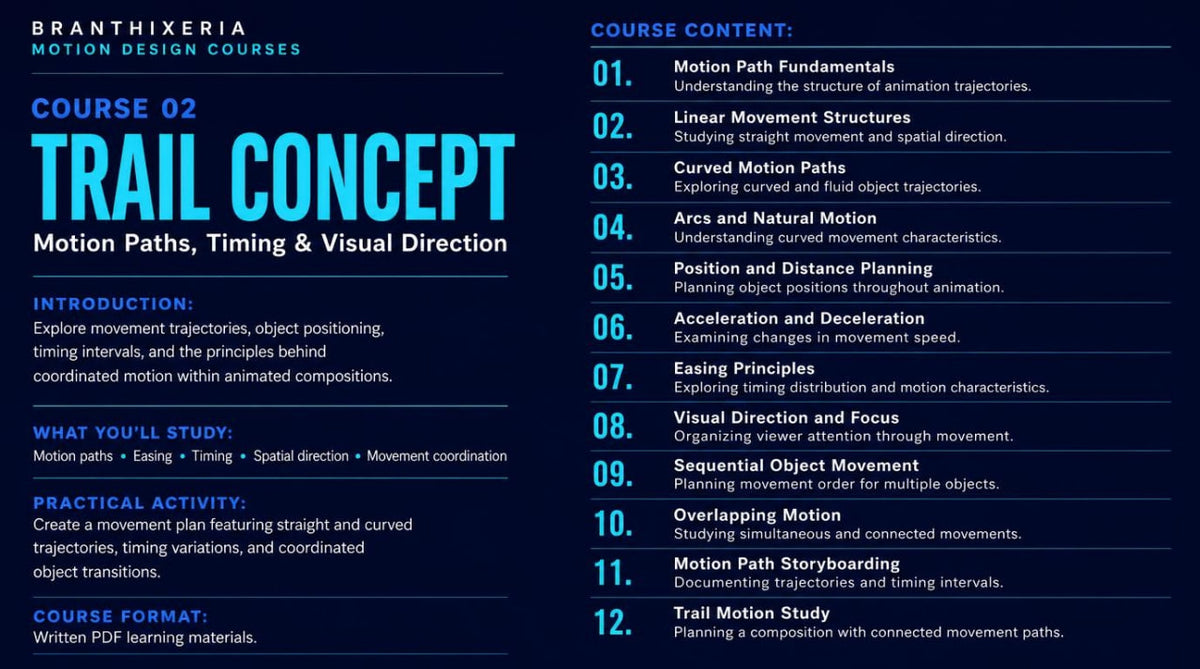
Trail Concept introduces a structured approach to studying movement paths and the timing of animated elements. The educational materials explain the differences between linear, curved, and combined motion trajectories. Dedicated sections examine changes in speed, intermediate object positions, and the planning of movement sequences. Practical examples demonstrate how movement direction interacts with composition, scale, and visual emphasis. Gradually working through these topics supports the development of analytical skills and independent animation planning.
3. What's Inside
Module 1: Motion Path Fundamentals
Study the structure of movement trajectories and their role in organizing animated compositions.
Module 2: Linear Movement Structures
Explore linear object movement, directional relationships, and spatial intervals.
Module 3: Curved Motion Paths
Examine curved trajectories and the principles behind constructing fluid movement.
Module 4: Arcs and Natural Motion
Investigate movement arcs and their application in expressive animation sequences.
Module 5: Position and Distance Planning
Study the relationships between starting, intermediate, and ending object positions.
Module 6: Acceleration and Deceleration
Explore acceleration, deceleration, and variations in speed throughout animation cycles.
Module 7: Easing Principles
Learn how movement can be distributed across time to create different motion characteristics.
Module 8: Visual Direction and Focus
Examine how movement trajectories guide viewer attention and support compositional structure.
Module 9: Sequential Object Movement
Study methods for organizing the sequential movement of multiple graphic elements.
Module 10: Overlapping Motion
Investigate overlapping movements and the timing relationships between animated objects.
Module 11: Motion Path Storyboarding
Create storyboards that document movement directions, key positions, and timing intervals.
Module 12: Trail Motion Study
Develop a practical concept for a short animated scene using several interconnected motion paths.
4. Who Is This For?
✅ Suitable if you:
- Have already explored the introductory principles of Motion Design.
- Want to examine movement trajectories and the characteristics of animated objects in greater detail.
- Are interested in the relationships between timing, space, and visual composition.
- Would like to plan object movements before developing an animated scene.
- Prefer written explanations, visual diagrams, and practical exercises.
- Want to gradually broaden your understanding of animation sequence organization.
❌ May not suit you if you:
- Have not yet studied frames, composition, or fundamental movement principles.
- Are looking specifically for advanced three-dimensional animation materials.
- Expect ready-made animation templates without explanations of their underlying structures.
- Require individual instructor-led training.
- Need a course focused on configuring a particular software environment.
5. What You'll Learn
- Distinguish between linear, curved, and combined movement trajectories.
- Plan starting, intermediate, and ending positions for animated objects.
- Analyze movement direction relative to the compositional center of a scene.
- Explain the relationship between movement distance and duration.
- Investigate acceleration and deceleration within different parts of an animation sequence.
- Explore easing principles for organizing movement characteristics.
- Plan pauses and timing accents between consecutive visual actions.
- Determine the movement order of several objects within a single scene.
- Examine overlapping motion and interactions between parallel animated actions.
- Use movement direction to organize visual attention.
- Analyze spatial balance while graphic shapes change position.
- Create schematic movement maps for short animated scenes.
- Prepare storyboards showing trajectories and timing intervals.
- Compare alternative movement paths for the same object.
- Develop a composition concept involving several interconnected animated elements.
6. Refund Policy
Paid Branthixeria courses include a 14-day period for submitting a refund request.
Requests are reviewed according to the store's published refund policy and applicable law. Separate conditions may apply to digital educational materials depending on how they are supplied and the consumer rights that apply.
What format are Branthixeria courses provided in?
What format are Branthixeria courses provided in?
Branthixeria courses are presented as written PDF coursebooks containing thematic modules, explanations, examples, and practical exercises. The materials are organized for sequential study, allowing learners to revisit individual sections whenever they wish to review a topic. Each course focuses on a defined range of Motion Design subjects.
Do I need previous Motion Design experience?
Do I need previous Motion Design experience?
The learning collection covers different stages of Motion Design study. Introductory courses explain fundamental concepts, while later materials explore more detailed animation principles, composition methods, and visual movement structures. We recommend reviewing each course outline before choosing your materials.
Can I study at my own pace?
Can I study at my own pace?
Yes. The written format allows you to plan your own reading time, examine examples, and complete exercises according to your schedule. You can revisit earlier modules, review specific subjects, and gradually explore additional concepts.